
On reading tarot for yourself, the Celtic Cross, and the fine art of putting things down.
There’s an old bit of advice floating around the tarot world that you shouldn’t read for yourself.
I’ve never entirely bought into that.
I’ve been reading tarot since I was seventeen. That’s nearly forty years of shuffling cards, considering archetypes, listening to my intuition, and occasionally looking at a spread and thinking, “Well, shit.”
Of course, reading for yourself has its pitfalls. We all have blind spots. We see what we want to see, avoid what we don’t want to acknowledge, and occasionally mistake our anxieties for intuition.
But I think the solution to that is greater self-awareness, not abandoning the practice.
I don’t approach tarot as a machine that dispenses immutable predictions about my future. I approach it as a conversation. With my intuition, my unconscious mind, and what I understand as the larger intelligence of the universe.
And sometimes that conversation is illuminating.
Sometimes it’s uncomfortable.
Sometimes the cards seem to take one look at my life and say, “Girl. We need to talk.”
Today was one of those days.
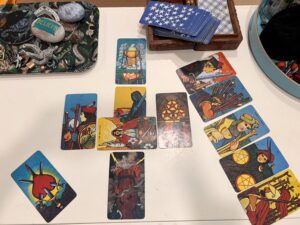
The old magic of the Celtic Cross
I’d just finished reading for a friend, and I was in that wonderful, slightly altered state of mind that comes from being deeply immersed in the work.
If you read tarot, you probably know what I mean. It’s the place where your analytical mind is still present, but something quieter has begun speaking alongside it.
I hadn’t done a proper reading for myself in quite a while, and I thought, why not?
I reached for my beloved Morgan-Greer deck, shuffled, and asked a simple question:
What do I need to know right now?
I use the Celtic Cross almost exclusively for substantial readings.
There’s something about it that other spreads don’t quite capture for me. It’s been used by countless readers over generations, and I like to think every reading contributes something to its collective symbolic energy.
Almost as though the more people use it, the deeper the groove becomes in the collective unconscious.
I know. Very Jungian of me.
But I genuinely feel something when I lay out a Celtic Cross. A kind of accumulated ritual power. Other spreads can be wonderful, but this one has juju.
I also have a little addition of my own.
After shuffling, I take the card at the bottom of the deck and place it beside the spread. This is my lens, the emotional atmosphere through which I interpret everything else.
My own little cosmic inquiry into what’s underneath all this nonsense.
Today, that card was the Three of Swords reversed.
Oh.
Well, hello there.
The wounded heart
The upright Three of Swords is one of tarot’s least subtle illustrations. A heart pierced by three swords.
Heartbreak. Sorrow. Betrayal. Grief. Painful truths.
Reversed, I often read it as the process of healing. The wound may still be tender, but something has begun to shift. Sometimes it can also point to unresolved grief, particularly when we haven’t allowed ourselves to acknowledge the depth of what we’ve experienced.
And I have experienced quite a bit.
Six years of living with stage four cancer will rearrange your mental and emotional furniture. Add the ordinary complications of being a human being, employment uncertainty, financial strain, concerns about housing, and the peculiar business of trying to create a meaningful future while your body has its own ideas about what you can reasonably accomplish.
It’s a lot.
There’s grief in that.
Not just grief for people or animals you’ve loved and lost, but grief for the life you imagined, the ease you once took for granted, and the versions of yourself that no longer fit.
So the Three of Swords reversed felt appropriate.
Not because I’ve finished grieving.
But perhaps because I’m beginning to understand that grief doesn’t have to be the organizing principle of the rest of my life.
The Tower, the Magician, and a rather unpleasant Five
At the center of my spread sat the Five of Swords, crossed by the Magician.
The Five of Swords is a contentious little beast. Conflict, competing interests, the possibility of being treated unfairly, and victories that come at too high a cost.
Given some of the circumstances I’m navigating, I could easily see this card as representing a potential employment dispute.
And yes, that possibility concerns me.
But tarot requires us to look beyond our first emotional reaction.
The Five of Swords was in the position representing my present atmosphere. It wasn’t an inevitable future event.
The Magician crossing it was particularly interesting.
Here is the archetype of conscious creation, resourcefulness, skill, and focused intention.
I’ve always identified with the Magician. I’m a maker, a writer, an intuitive, a teacher, and a person who can turn a peculiar idea into an actual thing.
But there’s a shadow side to being capable.
When you’ve spent your life figuring things out, you can begin to believe that figuring everything out is your responsibility.
And sometimes competence becomes its own rather elaborate prison.
Underneath these two cards, in the foundation position, was the Tower.
Now, the Tower can frighten even seasoned readers, particularly when life already feels precarious.
My first thought was about housing. I may have to move, and I very much don’t want to be forced into an upheaval I haven’t chosen.
But then I looked at its position again.
The Tower was in the foundation.
The past basis of the matter.
And I realized that the Tower has already happened.
In 2020, my entire understanding of my future changed. More recently, other structures I’d depended upon have become less certain.
My life has already experienced profound disruption.
The Tower doesn’t necessarily mean another disaster is coming.
Sometimes it simply acknowledges that the structures we once depended upon have been fundamentally altered, and we’re still learning how to live in the aftermath.
I don’t believe illness or hardship is sent to teach us lessons. Sometimes terrible things happen, and the universe doesn’t owe us a tidy explanation.
But we can still discover meaning in how we respond.
Those are two very different things.
Two Twos, and the exhausting business of being capable
The Two of Wands appeared in the position of influences passing away.
The Two of Pentacles appeared in the position of how others perceive my situation.
I love this symmetry.
The Two of Wands is about vision, personal authority, ambition, and considering possibilities.
I’ve been doing an awful lot of that lately. Dreaming, planning, developing creative projects, thinking about the person I want to become and the life I’d like to build.
But the Two of Pentacles is the practical reality of juggling resources and responsibilities.
Money. Work. Bills. Health. Everyday logistics.
And perhaps that’s how other people see me.
Someone juggling an extraordinary number of things while somehow managing to keep most of them from crashing to the floor.
What people don’t always see is how much energy the juggling requires.
There’s a strange irony in being resourceful.
The better you become at managing difficult circumstances, the easier it is for other people to assume you’re managing just fine.
And I am managing.
But managing and flourishing are not the same thing.
Something beautiful is taking shape
Above the center of the spread, in the crowning position of a possible future, was the Ace of Cups.
I nearly cried.
The Ace of Cups represents emotional renewal, love, intuition, compassion, spiritual connection, and the opening of the heart.
And it felt like the gentlest possible counterpoint to everything else.
I’ve spent so much of my life being things for other people.
A mother. A daughter. A caretaker. A guide. A business owner. The person who holds everything together.
But lately, I’ve been trying to explore who I am beyond those roles.
I want to write. I want to make beautiful things. I want to teach, create, laugh, learn, and reconnect with the devotional part of myself that has sometimes gone missing beneath the practical demands of living.
And yes, I want love.
Real, emotionally mature, reciprocal romantic love.
Someone who sees me, hears me, and doesn’t require me to be the capable one every minute of every day.
Which made the King of Cups appearing in my hopes and desires position especially meaningful.
This is an archetype of emotional maturity, tenderness, wisdom, and steadiness.
Perhaps he represents the qualities I’m developing in myself.
But I also think he represents something I’m longing to experience with another person.
And I don’t think there’s anything wrong with admitting that.
We can be perfectly good company for ourselves and still want someone to hold our hand.
The help that may already be on its way
The Three of Pentacles appeared in the position of forces already in motion that may manifest in the near future.
Collaboration.
Shared work.
The coming together of different skills to build something worthwhile.
Now we’re getting somewhere.
Because I have ideas. Good heavens, do I have ideas.
Books, oracle decks, candles, essays, videos, an entire creative world I’d like to bring into being.
And here’s the ridiculous thing.
I keep imagining myself doing all of it.
Writing the books, designing the products, building the website, developing the app, recording the videos, managing the business, and somehow finding the energy to live an actual life in between.
While navigating everything else.
The Three of Pentacles offers a different model.
Build with other people.
Ask for expertise.
Accept collaboration.
Recognize that something can be entirely yours without every component having to be created by your own two hands.
It’s a simple idea.
Apparently one that requires the universe to hit me over the head with a tarot card.
The warrior who is tired of fighting
In the position of feelings, fears, and apprehension was the Nine of Wands.
The battle-weary survivor.
Still standing. Still alert. Still protecting herself.
And profoundly tired.
I understand this card on a cellular level.
I’m not particularly worried about whether I can get through another difficult period.
I know I’m capable of surviving terrible things.
What frightens me is the thought of having to keep doing it.
Of never reaching the point where I can put down my defenses, stop anticipating the next crisis, and simply enjoy being alive.
I don’t want the rest of my life to become an extended demonstration of resilience.
I’d like a little softness, thank you.
A little delight.
Maybe some romance.
Possibly an afternoon in which nobody needs me to solve anything.
Wildly ambitious, I know.
And then came the Ten of Wands
The Ten of Wands occupied my final outcome position.
Well, shit.
After all that, the exhausted figure carrying an enormous bundle of responsibilities?
Seriously?
The Ten of Wands is about burden, overextension, responsibility, and the accumulated weight of everything we’re trying to accomplish.
I looked at the card and thought, I do not want to carry everything uphill into Happy Town.
I’ve done enough of that.
So I pulled one additional card to clarify the outcome.
And I got the Page of Swords.
Oh, I liked that.
The Page of Swords is curious, perceptive, questioning, mentally alert, and interested in discovering the truth.
He investigates.
He asks uncomfortable questions.
He examines assumptions.
And suddenly, the Ten of Wands began to look different.
Perhaps it wasn’t predicting a future in which I’m condemned to carry an ever-increasing burden.
Perhaps it was showing me the pattern that needs to change.
The Nine of Wands reflected my fear of continued struggle.
The Ten of Wands illustrated the consequences of continuing to carry everything myself.
But the Three of Pentacles had already introduced cooperation.
And the Page of Swords was asking me to think.
Why am I carrying this?
Is it actually mine to carry?
What information do I need?
Who can help?
What if the way I’ve always done things is no longer the way I need to do them?
The Page of Swords isn’t suggesting that I ignore my obligations. Quite the opposite. He’s asking me to approach them intelligently.
To gather facts.
To understand my options.
To communicate clearly.
And perhaps to stop mistaking self-sufficiency for strength.
So, should you read tarot for yourself?
Absolutely.
With one important qualification.
You must be willing to hear something other than what you want to hear.
You need enough self-awareness to recognize when fear is speaking, when desire is clouding your interpretation, and when you’re trying to make the cards confirm something you’ve already decided.
That’s not always easy.
But I don’t think avoiding self-readings makes us more intuitive.
I think learning to navigate those distinctions is part of becoming a better reader.
The cards don’t relieve us of responsibility for our choices.
They don’t replace medical advice, legal counsel, practical planning, or good old-fashioned common sense.
And they don’t eliminate uncertainty.
For me, tarot is not about surrendering my agency to fate.
It’s about becoming more conscious of the possibilities before me.
This reading didn’t tell me whether I’ll have to move, what will happen with my employment, when I’ll find love, or which of my creative projects will succeed.
It offered something more useful.
A chance to examine the way I’ve been living.
The way I’ve been carrying things.
And the possibility that the next stage of my life doesn’t have to look exactly like the last one.
I began this reading with the Three of Swords reversed.
The wounded heart in the process of healing.
And I ended with the Page of Swords, asking better questions.
Perhaps that’s the real movement here.
From pain to discernment.
From enduring to choosing.
From carrying everything alone to considering what might be possible with a little help.
I’m not interested in being told that everything I’ve endured was necessary to make me who I am.
I was already someone.
And I don’t need to romanticize suffering to find meaning in my life.
But I am interested in what becomes possible when I stop organizing that life entirely around surviving.
Maybe the Ten of Wands isn’t telling me to carry the bundle all the way to the finish line.
Maybe it’s telling me I can put the damn thing down.
And that, dear reader, is why I read tarot for myself.
For those interested in exploring tarot more deeply, I highly recommend Joan Bunning’s Learning the Tarot. Her thoughtful interpretations have been a valuable resource for readers for many years.
Deck: The Morgan-Greer Tarot. Spread: Celtic Cross, with my own additional underlying-energy card and a final clarification card.